Introduction
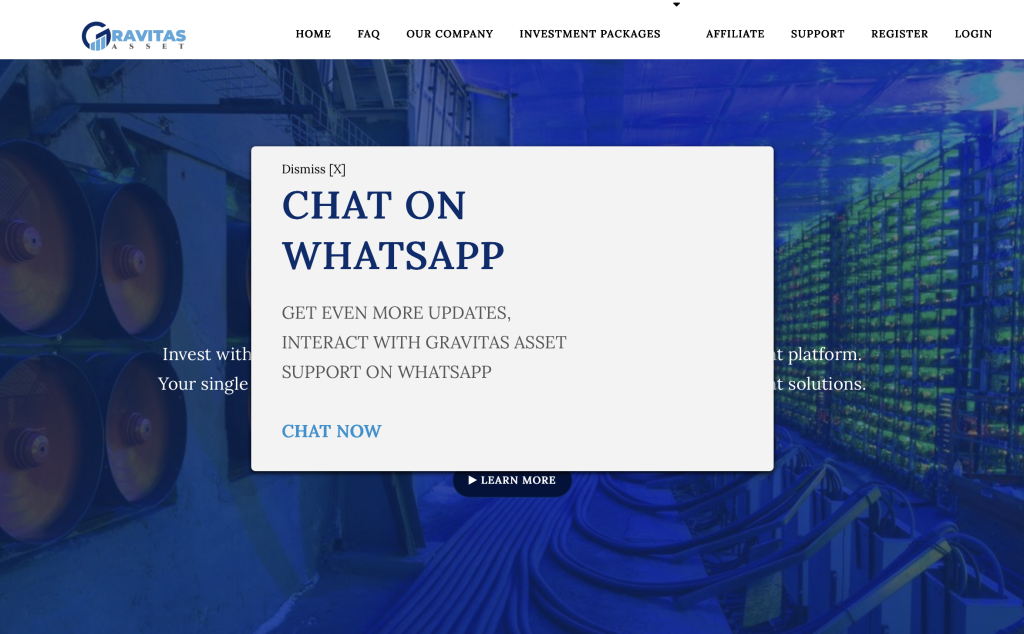
Gravitas-Assets.com presents itself as a polished, modern investment platform promising access to global markets, professional account management, and quick returns. The website’s wording leans on credibility terms—“secure,” “regulated,” “AI-driven,” and “expert team”—all designed to inspire trust. However, when you look past the surface, several serious warning signs appear.
This review breaks down those signals in everyday language: how the site pitches itself, where confusion or inconsistencies may arise, and what patterns commonly seen in high-risk platforms you should watch for. The goal isn’t to dramatize; it’s to help you evaluate risk with a clear, practical checklist before you make any decision.
First Impressions vs. Substance
At first glance, you may notice a slick homepage, generic market imagery, and strong claims. That’s not unusual—plenty of risky platforms invest in an impressive front-end while neglecting the basics that legitimate brokers treat as non-negotiable. When evaluating an investment site, focus less on the glossy graphics and more on verifiable details: licensing, transparent legal entities, consistent contact information, and clear, fair client terms.
Key early-page questions to ask:
Is there a clearly named legal company behind the website, with a registered address that can be independently verified?
Do the “About” and “Legal” pages contain specific, checkable information (company number, regulator, jurisdiction), or only broad marketing language?
Are support channels professional and consistent (matching corporate domains), or do they rely on free webmail or messaging apps?
Regulation and Licensing: The Core Test
For any platform offering brokerage-like services, the regulatory status is the most important factor. A properly authorized firm states:
Which regulator oversees it (e.g., FCA, ASIC, CySEC, etc.).
Its license/registration number and a link or clear instructions to look up the record on the regulator’s public register.
The legal name of the company that holds the license (this must match what appears on the regulator’s register and on the website’s legal footer and documents).
If these items are missing, vague, or inconsistent, that’s a serious red flag. High-risk sites often use phrases like “licensed,” “compliant,” or “globally regulated” without naming the actual authority. Some even cite an unrelated license number or a company that isn’t the true operator of the website. Treat any mismatch as a warning.
Unrealistic Returns and “Guaranteed” Outcomes
Language that promises “consistent weekly profits,” “guaranteed income,” or “zero-risk trading” is a classic hallmark of high-risk operations. Financial markets involve volatility. Even regulated firms never guarantee returns. If a platform implies that losses are virtually impossible—especially while pushing you to deposit quickly—you should pause.
Signals to note:
Fixed daily/weekly ROI “plans” regardless of market conditions.
Testimonials claiming outsized gains with minimal effort and no down weeks.
Vague references to “AI” or “proprietary bots” that supposedly beat the market without transparent methodology or third-party verification.
Bonuses, “Account Tiers,” and Withdrawal Complications
Another pattern commonly seen on questionable sites is the use of enticing deposit bonuses and tiered accounts that seem to unlock better spreads, faster withdrawals, or premium “advisors.” The catch often appears later, when users try to withdraw. Hidden terms can require extremely high trading volumes (or “turnover”) before withdrawals are permitted, or introduce unexpected “tax,” “liquidity,” “risk-management,” or “compliance” fees that must be paid first outside the platform.
Red flags in this category include:
Bonus clauses that quietly restrict withdrawals until unrealistic conditions are met.
Up-front clearance fees for withdrawals (legitimate brokers deduct fees from balances, not via separate payments).
Requests for additional deposits to “unlock” funds or “verify liquidity.”
Pressure Tactics and High-Touch “Advisors”
Many high-risk platforms assign “account managers” who communicate via messaging apps and use urgency to push higher deposits: “The market window closes today,” “You’ll miss the exclusive price,” or “Add funds so we can stabilize your position.” A knowledgeable, ethical advisor never needs you to move money quickly without time to review documents and risks.
Be cautious if:
You’re asked to share remote-desktop access or install third-party apps to “help” with transfers.
You receive repeated calls at odd hours urging immediate action.
Communication shifts away from official channels into private chats that leave little trace.
Website Structure and Transparency Gaps
Even without technical tools, you can spot several transparency problems by carefully reading the site:
Legal pages: Terms & Conditions, Risk Disclosure, Privacy Policy, and Complaints Procedure should exist, be detailed, and match the company’s stated jurisdiction. Generic templates that don’t name the actual operator—or documents that contradict each other—signal risk.
Contact details: Look for a verifiable physical address (searchable on public maps/business registries) and a corporate domain email. If only a form or a single free email is provided, caution is warranted.
Company identity: The “About” page should explain who runs the platform, not just what it does. If the team is unnamed and there’s no leadership profile, ask why.
Product clarity: Real brokers explain account types, fees, spreads, margin rules, leverage limits, and product risk. If everything is “premium” and “tailored” but specifics are missing, that’s a warning.
Technical Hygiene and Consistency Checks
You don’t need to be a developer to notice basic inconsistencies:
Brand mismatches: Different names or spellings across pages, PDFs, email signatures, or dashboards.
Broken elements: Non-functioning investor education links, placeholder text, or stock images with irrelevant captions.
Document metadata: Download a PDF from the site (e.g., T&Cs) and check its properties. If the author or company name doesn’t match the claimed operator, that’s suspicious.
Simple public checks anyone can do:
Domain age and history: New domains aren’t automatically bad, but short histories paired with big promises deserve scrutiny.
Consistency across channels: Do the website name, social profiles, and documents point to the same legal entity and address?
Payment and Custody Clarity
Legitimate investment firms clearly describe how client funds are held, how deposits/withdrawals work, and which payment processors and custodians are used. Look for:
Segregated client accounts and named banking partners.
Clear withdrawal timelines and standard KYC/AML steps (without unusual, ad-hoc “fees”).
A transparent fee schedule (deposits, withdrawals, inactivity, overnight financing) published on site.
If the platform only emphasizes how quickly you can deposit—while burying or skipping withdrawal details—that’s a practical warning sign.
Testimonials, Reviews, and “Awards”
Marketing claims about “thousands of happy clients,” “Top Broker 2024,” or five-star badges should be independently verifiable. If the site displays award logos without naming the awarding body and linking to the original announcement (on the awarding body’s domain), treat them as promotional graphics rather than evidence.
User testimonials with stock photos, first-name-only quotes, or identical phrasing across multiple profiles are a common pattern on high-risk sites. Look for consistency: names, dates, locations, and plausible outcomes.
Data Privacy and Security
Any platform handling personal and financial details must demonstrate responsible data practices. Review:
Privacy Policy depth: Does it specify data controllers, retention periods, and rights requests?
Cookie and tracking disclosures: Do they appear and function as expected?
Security cues: A valid certificate is basic; what matters is the firm’s overall security posture and whether data-sharing with third parties is transparent and justified.
A Practical Checklist Before You Risk Funds
Use this concise list to evaluate any such platform:
Regulator & License: Named regulator, license number, and a match on the public register.
Real Company: Full legal name, registration number, verifiable address, and consistent references across the site and documents.
Transparent Fees: Clear schedule; no up-front “withdrawal clearance” payments.
Withdrawal Rules: Standard timelines and conditions; no hidden turnover requirements from bonuses.
Communication: Professional channels; no pressure tactics or “urgent” deposit pushes.
Documents: Detailed T&Cs, Risk Disclosure, Privacy Policy, and Complaints Procedure that match the stated jurisdiction.
Identity Consistency: Same brand and company details across pages, PDFs, emails, and dashboards.
Track Record: Reasonable domain history and coherent public footprint.
Claims: No guarantees, unrealistic ROI, or unverifiable awards.
Support: Clear, responsive, and written in a way that answers policy and process questions—not just sales pitches.
If multiple items fail this checklist, consider the platform high-risk.
Frequently Asked Questions
Q1: Is Gravitas-Assets.com a regulated broker?
A legitimate broker clearly states its regulator and license number and explains how to verify it on the regulator’s public register. If you cannot confirm this, treat the website as high-risk.
Q2: The site offers bonuses. Is that good?
Bonuses can sound attractive, but they often come with turnover conditions that restrict withdrawals. Many reputable brokers avoid deposit bonuses entirely due to compliance and fairness concerns.
Q3: Why do some platforms ask for extra “tax” or “clearance” fees before withdrawal?
Introducing new, off-platform payments at the point of withdrawal is a major red flag. Standard practice is to deduct any lawful fees from your existing balance—not to demand additional, separate transfers.
Q4: The support team says I must act today to avoid losing an opportunity.
Urgency is a common pressure tactic. Ethical financial guidance allows time for due diligence, independent checks, and calm decision-making.
Q5: What kind of proof should I expect from a legitimate platform?
A verifiable regulator, a precise legal entity, consistent documents, a transparent fee schedule, and standard withdrawal processing—all easy to confirm independently.
Verdict
On balance, Gravitas-Assets.com presents multiple red-flag patterns commonly associated with high-risk investment websites. The combination of strong marketing claims, unclear regulatory status, potential withdrawal complications tied to bonuses or turnover, and an emphasis on rapid deposits over verifiable credentials should prompt serious caution.
Well-regulated investment firms lead with transparency: clear licensing, named legal entities, standard fees, honest risk disclosures, and plain withdrawal processes. If a platform cannot readily provide these—and if basic checks raise more questions than answers—the most prudent choice is to step back and reassess.
Empowering Victims: Taking a Stand Against Scams with GAINRECOUP.COM
If you have fallen victim to a scam, it is important to understand that you are not alone and you still have options. Scammers exploit the trust of their victims, but organizations like GAINRECOUP.COM work tirelessly to combat these frauds with integrity and expertise.