
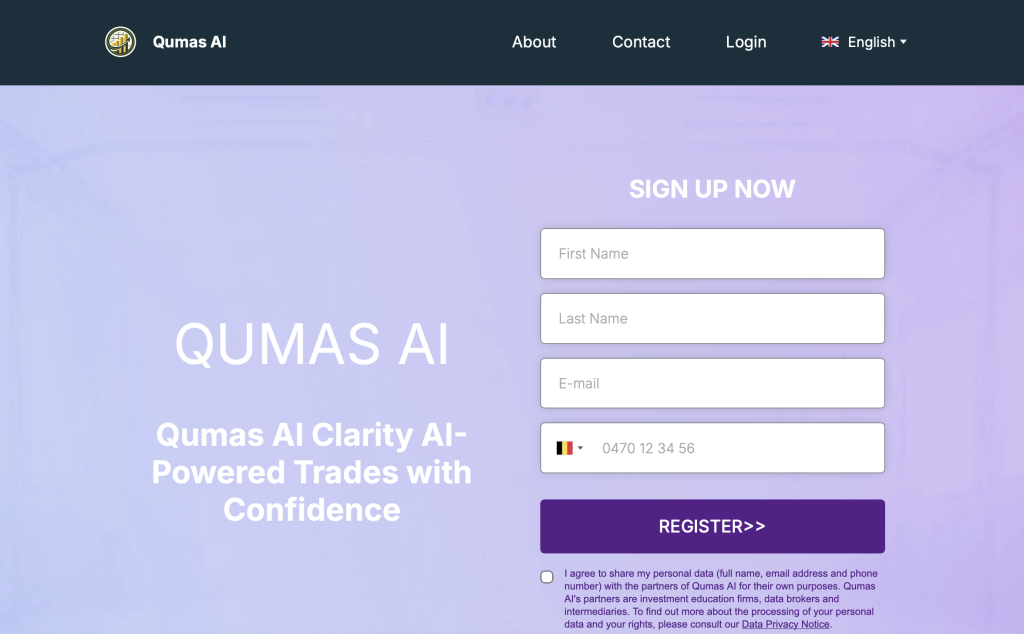
Snapshot: What Quma-AI.com Claims vs. What We Found
Quma-AI.com promotes an AI-driven trading or investing solution that promises to make complex markets accessible. The pitch leans heavily on buzzwords—“AI,” “automation,” “smart algorithms,” “hands-free profits.” At first glance, the site’s visuals and confident tone can feel persuasive. But when you strip back the marketing language and look for concrete evidence—verifiable ownership, licensing, transparent fees, consistent terms, and a credible track record—the gaps start to show.
This review compiles observable issues and risk factors. It does not make legal determinations; rather, it highlights warning signs that would concern a cautious, research-minded user.
Key Red Flags at a Glance
Shaky or obscured ownership: The site’s operators are not clearly identified with full names, roles, and a verifiable corporate entity you can check in public registries.
Licensing questions: Claims about providing financial services often require regulatory authorization in many jurisdictions. If licensing is vague or missing, risk increases.
AI hype without substantiation: “Proprietary AI” and “guaranteed accuracy” are big claims. When there’s no methodology, audit, or third-party validation, treat promises as sales copy—not proof.
Unclear business model: If revenue sources, fee schedules, and spreads aren’t transparent, it’s hard to understand how the platform actually makes money.
Aggressive performance language: Phrases implying consistent outsized returns signal unrealistic expectations. Legitimate providers emphasize risk as much as reward.
Testimonials without verification: First-name-only reviews, stock photos, or identical writing styles are classic credibility red flags.
Withdrawal friction: Reports or hints of “unlock fees,” “tax prepayments,” or ever-changing conditions before you can withdraw are hallmark risk patterns.
Pressure tactics: Countdown timers, “limited slots,” urgent messages, or relentless contact from “advisers” are designed to trigger impulse decisions.
Ownership, Company Details, and Traceability
A legitimate financial or trading service typically provides full corporate transparency: registered company name, registration number, physical address, key personnel, and a way to confirm these details in independent registries. If Quma-AI.com offers only generic contact forms or partial details, that’s a meaningful gap. Real businesses welcome verification because it builds trust.
Why it matters: If something goes wrong, transparent ownership gives you a starting point to seek redress. Limited traceability is a structural risk because it’s difficult to hold anyone accountable.
Regulation and Licensing: The Non-Negotiable Check
If Quma-AI.com is presenting services that look like brokerage, portfolio management, signals, or investment advice, the platform may require authorization from the relevant regulator where you live (and/or where the business claims to operate). Robust platforms showcase license numbers, jurisdictions, and links to official registers. The absence of clear, checkable licenses is a serious caution sign.
Plain-English takeaway: If a platform touches your money or tells you how to invest, it should be easy to confirm who regulates it. If that’s unclear, risk is high.
The AI Claim: Powerful Idea, Often Misused
“AI trading” is a popular pitch. But genuine AI systems involve datasets, models, validation, and performance auditing. Credible providers usually publish at least some technical overview, risk disclosures, and independently reviewed results. If Quma-AI.com leans on AI language without technical depth—no model descriptions, no risk metrics, no drawdown history—treat promises as untested marketing.
Ask yourself:
Where are performance stats (not just cherry-picked wins)?
Are results audited by a recognized third party?
Is there a clear risk disclaimer and an explanation of potential losses?
If the answer is “no,” you’re likely looking at hype over substance.
Pricing, Fees, and “Unlock” Conditions
High-risk sites often hide the true cost behind vague tiers or paywalls that only appear after you deposit. Another pattern: payouts are allegedly “locked” until you cover extra fees (e.g., “liquidity,” “compliance,” “withholding tax”). Legit platforms normally deduct legitimate fees from balances or disclose them clearly upfront—they don’t demand newpayments just to release your own funds.
Rule of thumb: If you must pay additional money to access your original balance or profits, that’s a major red flag.
Onboarding and KYC: Does It Make Sense?
Responsible financial services use Know Your Customer (KYC) to follow the law and reduce fraud. However, inconsistent KYC (e.g., requesting sensitive documents over chat, or shifting requirements mid-process) can indicate process risk. If Quma-AI.com’s onboarding feels improvised, or if “support” keeps moving the goalposts, pause and reassess.
Website Signals: Design vs. Substance
A polished front end does not equal a trustworthy back end. Evaluate:
Transparency: Is there a detailed About page with verifiable people and a legal entity?
Documents: Are terms of service, risk disclosures, and privacy policy consistent and specific—not generic boilerplate?
Contact: Is there more than a web form—e.g., a checked physical office address and a landline that actually connects?
Content quality: Are blog posts, FAQs, and platform guides detailed and original, or do they look copied or thin?
Update cadence: Do announcements and materials show regular, meaningful updates, or is the site largely static?
If the answers tilt toward ambiguity, caution is warranted.
Common User Experience Patterns Reported with High-Risk Platforms
While individual experiences vary, these patterns frequently surface in complaints about high-risk “AI trading” sites:
Early wins, then losses: Small test profits encourage larger deposits, after which performance mysteriously worsens.
Escalating deposits: “Account manager” pushes upgrades or larger balances to “unlock” the full AI strategy.
Blocked withdrawals: Requests stall; support cites new fees, “anti-money-laundering holds,” or “tax clearances.”
Communication shift: Friendly at first, then unresponsive or confrontational once you ask about payouts.
Re-routing attempts: You’re told to “migrate” to a new site or app, allegedly with better security or features—another reset that avoids paying out.
These patterns don’t prove misconduct by themselves, but taken together, they form a risk profile that serious investors avoid.
Balanced Risk Assessment (What We’d Want to See)
To view Quma-AI.com more favorably, a cautious user would reasonably expect:
Clear corporate identity with a registered, verifiable company and leadership team.
Regulatory authorization (license numbers, jurisdictions, and an easy way to confirm).
Detailed risk disclosures and realistic performance language—no guarantees.
Independent audits or third-party reviews of any stated results.
Transparent pricing and no “extra fees” to process withdrawals.
Consistent KYC process that respects user privacy and follows best practices.
Reliable customer support with traceable communication and resolution timelines.
If these items remain absent or weak, the risk remains elevated.
Practical Due-Diligence Checklist (No Links)
Use this simple framework before engaging with any “AI trading” platform:
Identify the legal entity, confirm it in an official registry, and verify the people behind it.
Check for applicable licenses in your jurisdiction.
Read the entire Terms, Risk Disclosure, and Privacy Policy—look for contradictions or vague clauses around withdrawals and fees.
Test support: ask precise questions about fees, custody, execution, slippage, and risk controls. Evaluate the quality of answers.
Start small if you proceed at all, and never escalate based on pressure or promised unlocks.
Document every interaction, screenshot balances, and track all requirements you’re asked to fulfill.
Final Verdict
Based on the signals outlined in this Quma-AI.com scam review, the platform presents multiple red flags typical of high-risk online investment schemes: unclear ownership, questionable or absent licensing, AI-driven promises without independent validation, and potential withdrawal friction. While this review cannot declare legal wrongdoing, the overall risk profile appears high.
If a platform truly offers lasting value, it generally welcomes verification, regulatory clarity, transparent fees, balanced risk language, and independent oversight. Until Quma-AI.com convincingly checks those boxes, a careful reader would treat its claims with significant caution and avoid committing funds they cannot afford to lose.
Empowering Victims: Taking a Stand Against Scams with GAINRECOUP.COM
If you have fallen victim to a scam, it is important to understand that you are not alone and you still have options. Scammers exploit the trust of their victims, but organizations like GAINRECOUP.COM work tirelessly to combat these frauds with integrity and expertise.