
Introduction
In the ever-expanding world of online trading and investment platforms, it’s common to find sites that promise quick access to global markets, “professional tools,” and high returns. These offers can feel empowering. However, when promises outpace transparency, risk becomes much more than just market risk—it becomes platform risk. This review examines the website EconomicLiteracy.net, probing its claims, structure, transparency, and warning signs commonly found in high-risk financial sites. The goal is to empower all readers—regardless of experience level—to recognise caution flags and make informed decisions.
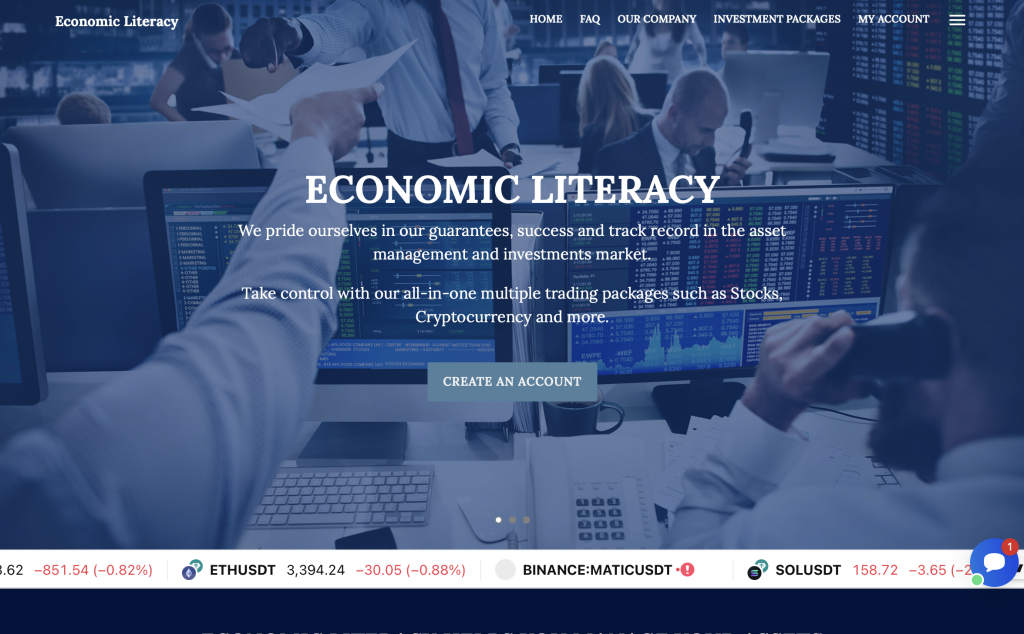
What EconomicLiteracy.net Portrays Itself to Be
On its homepage and “About Us” section, EconomicLiteracy.net positions itself as an advanced platform offering trading in forex, stocks, ETFs, options and a suite of “investment opportunities” for “investors worldwide.” It uses phrases like “dedicated to helping investors around the world reach their desired investment goals” and “our platform is meticulously crafted to cater to the diverse needs of global clients.”
Such messages, inclusive and inviting, suggest accessibility and global reach. But behind the inclusive tone lies a question: Are the operational, legal and risk-support fundamentals equally accessible and clear? When a site emphasises ambition and access more than detailed structural transparency, caution is warranted.
Design & Messaging vs. Underlying Substance
At first glance the site looks polished: a clear signup/registration page, plans with different deposit tiers, and a login interface that suggests real-world account access. There is even a “Plans” page listing deposit amounts, leverage up to 1:500, spreads from “1.2 pips” or “0.8 pips” depending on deposit size.
However, key questions emerge upon closer inspection:
Where is the legal entity registered? What jurisdiction governs it?
What regulator authorises the services? Is that information easily verifiable?
Are the risks and costs clearly stated upfront (e.g., spreads, swap rates, margin rules)?
Are withdrawal terms given in clear language, and visible before deposit?
When the design is slick but such foundational details are missing or minimal, the polished exterior may overshadow a lack of structural support.
Regulation and Licensing: The Credibility Benchmark
One of the strongest signals of a legitimate trading platform is clear, verifiable regulation by a recognised financial authority—published license number, regulator name and jurisdiction. This provides investors with oversight, client protections (segregated funds, audits) and complaint mechanisms.
In the case of EconomicLiteracy.net, the regulatory status is unclear or not prominently displayed in a way that can be independently verified. Without visible credentials, users effectively trade on trust rather than documented oversight. That raises several considerations:
Are user funds held in segregated accounts under a regulated entity?
Is there a robust dispute resolution process for users?
Are trading conditions consistent with those required by regulated platforms (leverage caps, risk warnings)?
When such foundations are weak or opaque, risk levels rise—not only from markets, but from operational assumptions too.
Bold Return Claims, High Leverage & “Premium” Access
Going deeper, EconomicLiteracy.net’s plans page shows deposit amounts (e.g., $1,000 USD, $10,000 USD, $100,000 USD) with leverage up to 1:500 and spreads from as low as 0.8 pips for the largest tier. These features—high leverage, very tight spreads, tiered “premium” access—are popular in marketing. Yet they also merit scrutiny:
Leverage of 1:500 is extremely high, which amplifies risk as much as potential reward. Many regulators limit leverage for retail clients precisely because of that risk.
Spread claims like “0.8 pips” need context (asset class, time, volatility) and full cost disclosure.
Tiered plans that hint “better deals if you deposit more” may shift platform incentive toward attracting larger deposits rather than service quality.
When layout emphasises “more deposit = better terms” that invites further questions about fairness, transparency and exit flexibility.
Onboarding Flow & Data Capture
The platform has a rapid account creation process: you can sign up, choose a plan, deposit and trade. On the surface, that’s inclusive and efficient. Yet effective onboarding is not simply about speed—it is about clarity, informed consent and support. Some key questions:
Are you given full terms and conditions before choosing a plan or depositing?
Does the data you give early reflect only standard KYC (Know Your Customer) or more extensive data capture to push you toward conversion?
Is there pressure to upgrade to “higher tier” plans or “unlock features” quickly?
Inclusive platforms welcome questions, provide educational materials, and build trust over time. If onboarding feels like a funnel pushing toward deposit and upgrade before you’ve understood rights and obligations, the model deserves caution.
Withdrawal Terms, Exit Conditions & Hidden Clauses
One of the most important stress-tests for any platform is: when you want to withdraw, how easy is it? High-risk platforms frequently display patterns such as:
Withdrawal rules or fees that only become visible after deposit or “upgrade.”
Locked funds until you’ve traded a large volume or reached an “unlock” threshold.
Sudden “risk review” or “security clearance” messages when you request withdrawal.
Changing terms or moving goalposts when a user wants to exit.
In the case of EconomicLiteracy.net, while there is a “Plans” page with deposit tiers, there is limited upfront visible detail about the withdrawal procedure, potential lock-in periods or minimum withdrawal amounts in simple language. That creates an opaqueness that reduces user agency.
Communication Style & Sales Pressure
Genuine investment services typically emphasise transparency, provide educational material, allow users to test or demo, and don’t force ‘upgrade now’ pressure. On the other hand, more aggressive platforms rely on tactics like:
Frequent “account managers” reaching out encouraging higher deposits.
Urgency messaging (“limited spots,” “exclusive”, “today only”).
Promises that “you’ll miss out” if you don’t upgrade.
Promoting compensation or return narratives with minimal mention of loss risk.
If you feel like the service is pushing you more than helping you, that’s a red flag. Inclusive platforms hold space for questions, recognise caution, and prioritise transparency over pace.
Testimonials, Social Proof & Verification
EconomicLiteracy.net presents testimonial-style statements: “Our clients worldwide…” “See how your portfolio grows…” These are part of marketing. Whether they reflect independent user experience is another matter. Good questions to ask:
Are testimonials verifiable (names, dates, amounts, independent sources)?
Do you see balanced feedback or only perfect success stories?
Are user reviews available outside the platform (forums, independent review sites)?
Could the images used be generic stock photos?
If the social proof is uniformly positive, uses minimal detail, and cannot be independently verified, treat it as marketing—not proof.
Legal Pages, Risk Disclosures & Data Privacy
Strong platforms publish extensive, clearly readable documents: risk disclosures, terms of service, privacy policies, data handling processes, dispute mechanisms and regulator details. Some warning signs include:
Legal pages that are generic or undated.
No clear company registration address.
Privacy policy that allows broad “sharing with partners” without specifics.
Risk disclosure buried or poorly worded.
In the case of EconomicLiteracy.net, while there are pages for Terms and Conditions and Privacy, the detail needed to evaluate withdrawal rights, complaint-handling, cost structures and exact jurisdiction is minimal or unclear. That reduces clarity for users.
Recognising the Pattern: Aggregating the Flags
When you aggregate the characteristics highlighted above, you see a pattern common in higher-risk trading platforms:
Attractive, inclusive design promoting many asset classes and “global access.”
Clear deposit tiers with high leverage and upgrade incentives.
Limited visible regulation or jurisdictional clarity.
Fast onboarding with early push toward deposit/plan selection.
Insufficient upfront information about exit/withdrawal conditions.
Marketing-heavy communication and bright promises of return.
Social proof that lacks independent verification.
None of these individually guarantee a platform will fail or defraud users—but combined they raise the risk posture significantly.
Balanced Understanding: Why These Platforms Attract
It’s understandable why platforms like EconomicLiteracy.net attract users. They offer:
Accessibility: sign up from anywhere, trade many asset types.
Inclusivity: “for global investors,” “any skill level.”
Promise: “better deals if you deposit more,” “premium access.”
Simplicity: fewer steps, fewer barriers.
For many people, that can feel like empowerment—especially if traditional finance feels distant. But, empowering access should come with transparent infrastructure. Accessibility without clarity can undermine long-term safety.
Final Verdict
Putting all factors together—presentation, deposit tiers, unclear regulatory credentials, high leverage, limited visible withdrawal clarity—EconomicLiteracy.net exhibits multiple warning signs that suggest elevated risk relative to a fully transparent, regulated trading platform. While it may function for some time, the structural lack of full clarity means the burden of caution is high.
If you are considering using this site, ask yourself:
Can I independently verify the licence, regulator and jurisdiction?
Are the fees, spreads, exit conditions fully visible before I deposit?
Does the communication feel supportive rather than pressure-driven?
Do I feel comfortable with the clarity of withdrawal terms, right now?
In online investing, transparency is not optional—it is essential. Platforms that prioritise rapid conversion, broad promises and upgrade incentives without matching transparency may expose you to platform risk beyond just market risk.
Empowering Victims: Taking a Stand Against Scams with GAINRECOUP.COM
If you have fallen victim to a scam, it is important to understand that you are not alone and you still have options. Scammers exploit the trust of their victims, but organizations like GAINRECOUP.COM work tirelessly to combat these frauds with integrity and expertise.