Overview
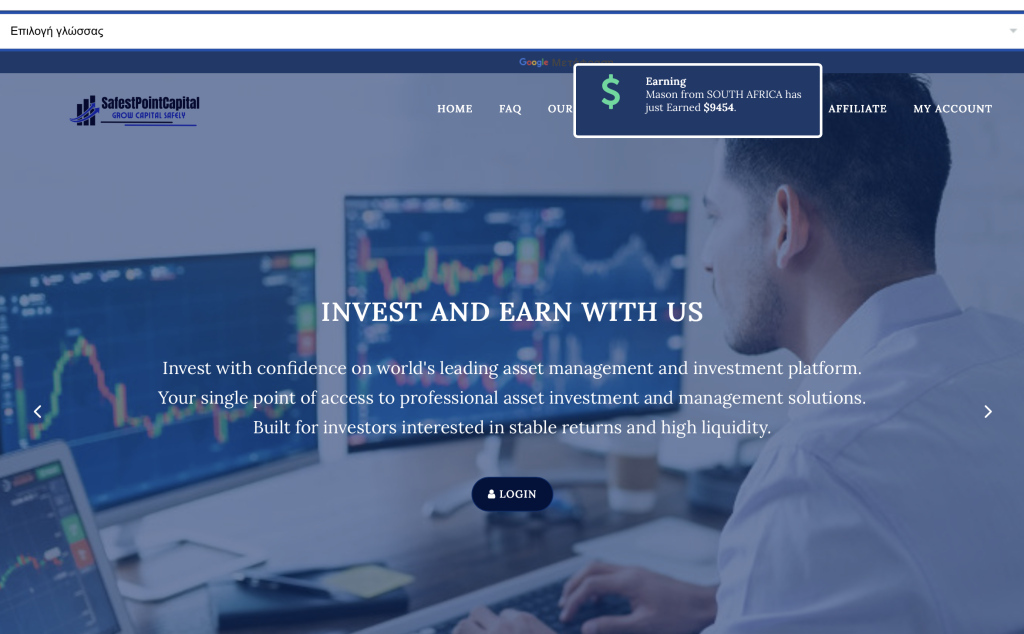
SafestPointCapitals.com presents itself as a digital investing venue with a polished interface and confident messaging about access to global markets. At first glance, it looks credible: modern visuals, reassuring copy, and an emphasis on “security” and “performance.” However, a professional-looking site is not proof of reliability. This review examines the kinds of checks a careful investor would perform—ownership clarity, regulatory status, fees and withdrawal terms, communication patterns, technical security, and overall user experience—to help you form your own view of the platform’s risk profile. Wherever possible, the analysis focuses on observable website traits and well-established best practices, avoiding speculation.
Brand Presentation vs. Verifiable Substance
A common pattern across high-risk investment websites is heavy emphasis on branding paired with sparse verifiable details. Ask: does the site clearly identify a legal company name (not just a brand), along with a registered business number, physical address that maps to actual office space, and team members whose identities can be independently verified? If the site relies on glossy promises while relegating corporate specifics to vague footers—or if “About” content is generic and lacks references to jurisdictional oversight—it may be relying on appearance rather than accountability. Strong platforms typically lead with verifiable company information and provide links to regulators or public registers where their licenses can be confirmed.
Licensing and Regulatory Clarity
Regulatory transparency is one of the most important markers of trust. Legitimate brokers and investment firms generally publish their regulator, license number, and the exact legal entity holding that license. If SafestPointCapitals.com does not clearly display a regulator (e.g., FCA, ASIC, CySEC, etc.), makes only broad claims like “fully compliant,” or lists multiple jurisdictions without a specific license identifier, that is a material concern. Even when a license number is claimed, the number should be cross-checkable on the regulator’s official database and should match the legal entity named on the site. Ambiguity here does not automatically mean wrongdoing, but it does elevate risk because it limits avenues for recourse if disputes arise.
What to look for:
The full legal name of the operating company, not just the brand.
License number(s) and regulatory body with a direct path to verify independently.
Jurisdiction-appropriate disclosures (client money rules, risk statements, complaint channels).
Segregation of funds and whether the regulator requires it.
Terms, Fees, and Withdrawal Conditions
Reputable platforms make it easy to find and understand fees and withdrawal terms. Red flags include:
Unclear or shifting fee structures (e.g., “performance fees” or “compliance fees” that appear only at withdrawal).
Mandatory “tax,” “clearance,” or “unlock” payments before releasing funds—legitimate brokers do not require pre-paid charges to withdraw your own balance.
Minimum withdrawal thresholds that are unusually high or increase over time.
Clause stacking—dense terms that add hurdles after you attempt to cash out.
If SafestPointCapitals.com’s policies are vague, inconsistent across pages, or only explained after you request a payout, consider that a serious risk signal. Transparent firms publish fee tables, timelines (e.g., “1–3 business days”), and a predictable, documented process.
Promised Returns and Performance Claims
Another common risk marker is overly confident profitability language. Any website suggesting guaranteed or near-certain returns—especially in volatile markets—should be treated carefully. Sustainable firms describe risk, stress market uncertainty, and refrain from projecting easy profits. Look for:
Back-tested results with methodology and disclaimers (and ideally third-party verification).
No promises of fixed daily/weekly ROI—credible managers avoid this framing.
Clear risk warnings proportional to the product offered (CFDs, crypto, options, etc.).
If SafestPointCapitals.com leans on “assured outcomes,” “VIP signals that never miss,” or claims of “risk-free earnings,” these are strong caution indicators from a consumer-protection perspective.
On-Site Communication Patterns
How a platform engages with prospects matters. Persuasive tactics are not inherently bad, but certain patterns correlate with higher risk:
Urgency pressure: countdown timers, expiring “exclusive slots,” or pushy live chat prompts urging immediate deposits.
High-touch messaging via unsolicited calls or messaging apps nudging you to “top up” for better returns.
Inconsistent support identities: advisors use changing names or contact handles across emails, chat, and phone.
No durable ticketing trail: issues resolved only through ad hoc chat threads.
A reliable platform typically provides stable support channels, a ticket history, and consistent identity across communications. If SafestPointCapitals.com displays hard-sell behavior or moves conversations off-platform to private messengers without record, note the risk.
Social Proof and Testimonials
User testimonials can be helpful, but they are also easy to fabricate. Scrutinize for:
Stock photos used as “clients,” duplicate names, or identical wording across multiple “reviews.”
No negative feedback anywhere on the site (an unrealistic signal).
Off-site presence alignment: does the company’s claimed social footprint (LinkedIn, industry forums, professional directories) match the magnitude of clients and volume they advertise?
Authentic social proof typically includes verifiable third-party coverage, team members with professional histories, and consistent brand-entity mapping across platforms. If SafestPointCapitals.com presents only glowing, non-verifiable blurbs, treat them as marketing, not evidence.
Technical and Security Posture
A website’s technical hygiene won’t guarantee legitimacy, but it can reveal professionalism:
SSL and modern TLS with a valid certificate for the exact domain.
Accurate company details in privacy policy and terms, including data controller information.
Responsible data capture: forms that request sensitive information should justify why it’s needed, and the site should describe storage and retention practices.
Cookie and consent management that aligns with the site’s stated jurisdiction.
Clean UX without scripts that trigger permission pop-ups or redirect loops.
If SafestPointCapitals.com asks for extensive personal or financial data before account verification, or lacks a coherent privacy framework, consider the implications for your data security.
Domain-Level and Web Footprint Checks
Simple open-source checks can reveal useful signals:
Domain age and change history: very new domains are not inherently bad, but short histories paired with big promises may warrant caution.
Consistent brand footprint across subdomains, support portals, and knowledge bases.
Email reputation: do official emails align with the core domain (e.g., support@the-same-domain) rather than free webmail?
Press or legal notices: credible firms often have a track record that can be traced through directories, conferences, or regulator publications.
If SafestPointCapitals.com has a minimal trace beyond its own pages—or multiple near-identical “sister” sites using recycled templates and slightly altered names—that consolidation pattern should be weighed carefully.
Usability, Education, and Client-First Design
User-centric firms typically invest in clear education (risk primers, platform tutorials, realistic walkthroughs), sandbox or demo modes, and transparent onboarding. Signs of maturity include:
Detailed FAQs that address tough questions (liquidity, slippage, order rejections, corporate actions).
Accessible policies written in plain language.
Measured tone that acknowledges both opportunity and risk.
If SafestPointCapitals.com focuses mostly on deposits and account funding while offering little substantive education or tool depth, that imbalance may reflect priorities misaligned with long-term client outcomes.
Balanced Risk Score (Qualitative)
While only you can decide whether to use any platform, a practical way to synthesize the above is to consider five dimensions and rate what you observe:
Regulatory Transparency – Is licensing explicit, verifiable, and jurisdiction-appropriate?
Withdrawal Predictability – Are fees, timelines, and processes clear and consistent?
Marketing Claims – Do they avoid “guaranteed returns” and provide balanced risk language?
Identity & Accountability – Is there a real company, real people, and reachable offices?
Security & Data Stewardship – Do privacy policies, SSL, and consent practices meet norms?
If SafestPointCapitals.com scores low on multiple dimensions, treat it as elevated risk. If it scores reliably on each, the platform may be closer to industry best practice—but continue to verify claims independently.
Practical Questions to Ask Any Investment Site
Who regulates you, and what is the license number?
What legal entity holds client funds, and where are those funds kept?
What are all fees I may face—upfront, ongoing, and at withdrawal?
What is your precise withdrawal timeline, and can I see the policy before depositing?
Can you provide third-party verification for performance claims?
Where can I find your complaints process, and what dispute resolution body applies?
Do your email domains, social profiles, and team identities align consistently?
As you review SafestPointCapitals.com, the answers to these questions will help you determine whether the site’s promises are matched by transparent, verifiable structures.
Conclusion
SafestPointCapitals.com positions itself as a gateway to market opportunities, with a design that may inspire confidence at first glance. For a decision as important as where to place your capital, the key is verifiability: clear licensing and regulation, predictable withdrawal processes, measured claims, transparent ownership, and strong data practices. If any of these pillars are vague, inconsistent, or absent, the overall risk profile rises. Conversely, if the site offers specific, checkable answers to the hard questions above, it more closely resembles a platform built for long-term trust.
Empowering Victims: Taking a Stand Against Scams with GAINRECOUP.COM
If you have fallen victim to a scam, it is important to understand that you are not alone and you still have options. Scammers exploit the trust of their victims, but organizations like GAINRECOUP.COM work tirelessly to combat these frauds with integrity and expertise.